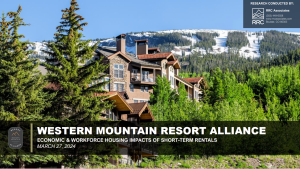


At the 2025 Greater Western Chapter of the Travel & Tourism Research Association (GWTTRA) One West Summit, RRC Associates’ Jeremy Sage presented new research on the role of short-term rentals (STRs) in resort communities. This work, conducted in partnership with the Western Mountain Resort Alliance (WMRA) and Inntopia, highlights both the economic contributions and the housing pressures tied to STRs in communities like Summit County, Colorado.
The Balancing Act for Destination Communities
Across the West, destination communities are facing two realities about short-term rentals:
- Economic Drivers – STRs play a critical role in the tourism economy, generating billions in visitor spending, tax revenue, and jobs.
- Housing Pressure – STRs exist within an already tight housing market where affordability and workforce availability remain pressing concerns.
Understanding the true scale of STR impacts is essential for policy makers, community leaders, and destination managers seeking to strike the right balance.
Our Research Approach
To move beyond assumptions, RRC applied a multi-layered methodology:
- Market Profile Analysis: Leveraging data from AirDNA, Key Data, and public records to understand the distribution and ownership of STRs.
- Economic Impact Modeling: Estimating visitor spending, tax revenue, GDP contributions, and labor income tied to STR activity.
- Housing Market Analysis: Linking STR activity with assessor records, MLS data, and hedonic valuation modeling.
- Community Sentiment Surveys: Gathering resident perspectives on STRs and potential regulatory approaches.
This framework provides data-driven insights that communities can rely on when making policy decisions.
Key Findings from Summit County, Colorado
- STRs are an economic engine. In 2022, STRs supported an estimated 7,693 jobs and generated $1.7 billion in economic output in Summit County. Visitors staying in STRs contributed more than $70 million in local taxes.
- Most STR owners are small-scale. Ninety percent of STR owners operate just a single property; only 10% manage more than one unit.
- Housing affordability is complex. From 2018–2022, STR supply actually declined slightly, while home prices surged by up to 86%, pointing to broader demographic and economic forces at play.
- Unit mix matters. Nearly 98% of STR listings are entire units, but many are condos rather than single-family homes, shaping how STRs interact with the local housing stock.
What It Means for Destination Communities
RRC’s findings show that short-term rentals in resort communities are neither a silver bullet nor a scapegoat. They provide indispensable lodging capacity and economic vitality but require smart management and policy frameworks to mitigate neighborhood and housing impacts. Communities exploring STR regulation should:
- Ground decisions in local data on short-term rentals rather than broad assumptions.
- Recognize STRs’ place in a wider ecosystem that includes housing, labor markets, and tourism.
- Consider targeted policies (e.g., licensing, zoning, caps by geography) that align with local priorities.
Ready to Explore STR Impacts in Your Community?
RRC’s research is already helping leaders in Summit and Pitkin Counties (CO) and Teton County (WY) shape smarter strategies around STRs. Full reports are available through the Western Mountain Resort Alliance: STR’s Impact Study | Resort Alliance.
If your community is facing questions about STRs—whether around housing, economic impacts, or community sentiment—we’d love to talk.
Contact us to learn how RRC can help bring the same level of clarity and insight to your destination.